


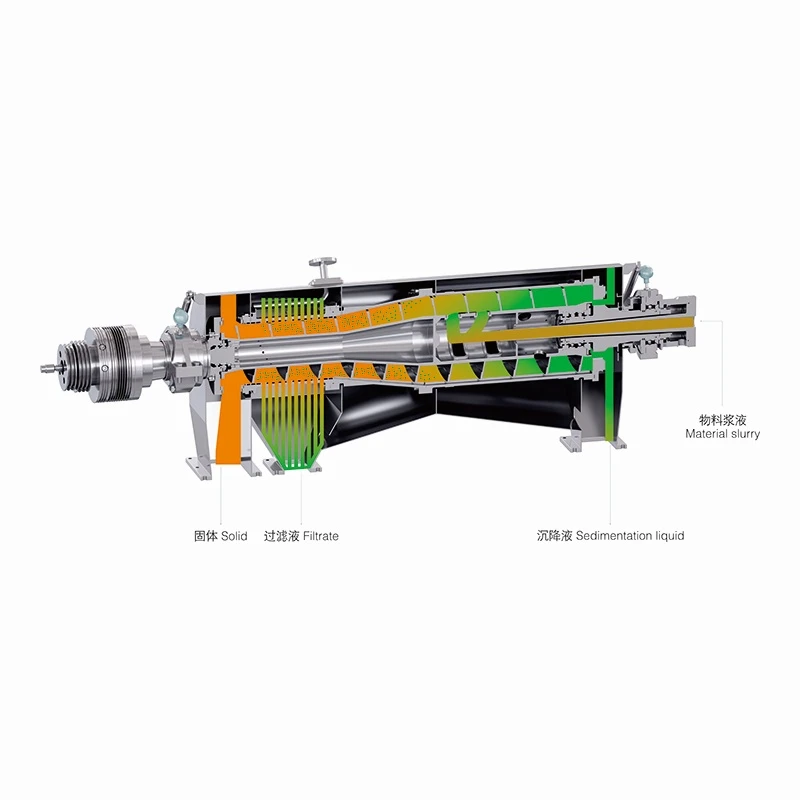


Overview
Industrial material separation testing helps manufacturers assess separation feasibility and process performance before pilot testing or industrial equipment selection. Test plans are tailored to material properties and separation objectives.

Integrated Centrifuge Testing with Nitrogen Protection and Process Monitoring
The testing system integrates centrifuge operation, nitrogen protection, oxygen detection, pressure monitoring, and solids discharge.
|
System Component |
Function |
|
Centrifuge |
Performs centrifugal separation |
|
Nitrogen protection system |
Supplies nitrogen to designated points |
|
Oxygen detector |
Monitors oxygen concentration |
|
Pressure transmitter |
Measures system pressure |
|
Solid discharge assembly |
Discharges separated solids |
|
Liquid seal device |
Supports liquid sealing |
|
Hydraulic station |
Powers compatible hydraulic components |
|
Control system |
Supports equipment operation and monitoring |
The system supports the evaluation of separation behavior, operating conditions, and material discharge performance. Applicable limits depend on equipment configuration and material properties.


Equipment Scope and Test Conditions
Testing feasibility depends on the available equipment configuration, operating limits, and separation requirements.
Operating Limits: Rotational speed, temperature, and pressure must remain within verified equipment limits.
Available Test Methods: Centrifugal sedimentation, centrifugal filtration, or other methods supported by the equipment.
Separation Objectives: Evaluation of solid–liquid separation or other separation duties supported by the system.
Nitrogen Protection: Available only under verified operating conditions and approved material-handling procedures.
Safety Restrictions: Hazardous, volatile, corrosive, or reactive materials require prior technical and safety review. Acceptance is subject to approval.
Test Variables and Evaluation Criteria
Test parameters are selected according to material properties, separation objectives, and equipment capabilities.
|
Evaluation Area |
Parameters or Indicators |
|
Feed Characteristics |
Solids concentration, particle size, and relevant material properties |
|
Operating Conditions |
Rotational speed, test duration, and adjustable parameters |
|
Solid-Phase Performance |
Cake moisture content and solids recovery, where applicable |
|
Liquid-Phase Performance |
Separated-liquid quality based on agreed analytical indicators |
|
Comparative Evaluation |
Results under selected test conditions |
Each test plan specifies the operating conditions and measurements for the project.
How Test Results Support Process Evaluation and Equipment Selection
Separation Feasibility: Assess whether the target solid–liquid or liquid–liquid separation can be achieved under the tested conditions.
Performance Targets: Compare solids recovery, cake moisture, and separated-liquid quality against agreed requirements.
Capacity and Operating Conditions: Evaluate feed rate, solids loading, and operating settings relevant to processing requirements.
Centrifuge Selection: Match separation duty, particle characteristics, discharge requirements, and batch or continuous operation to a suitable configuration.
Scale-Up Validation: Identify performance and capacity requirements for further pilot testing or validation under representative conditions.
From Material Assessment to Test Results
01 - Material Review
Review material properties, separation objectives, and sample requirements.
02 - Test Planning
Define test methods, operating conditions, and measurement criteria.
03 - Separation Testing
Conduct the agreed tests and record operating conditions and observations.
04 - Results Reporting
Compile measured data and findings according to the agreed test scope.
Test Report and Deliverables
Standard Deliverable
- PDF Test Report: Sample identification, test objective, test method, equipment configuration, operating conditions, measured results, observations, and conclusions.
- Results Table: Recorded operating parameters and measured indicators, with units and test conditions.
- Comparative Results: Side-by-side comparison of tested conditions when multiple conditions are evaluated.
Available by Agreement
- Raw Data Files: Original instrument records or exported measurement files, where available.
- Test Photos or Videos: Images of the test setup, sample, or separation results, where recorded.
- Additional Analysis: Laboratory analysis of separated solids or liquids, if included in the agreed scope.
- Written Technical Recommendations: Findings, identified limitations, and recommended follow-up tests or pilot validation.
Information Required Before Sample Shipment
Please provide the following information for an initial assessment:
Material Details: Material name, composition, solids concentration, particle size, viscosity, pH, and relevant chemical properties, where known.
Separation Targets: Target material or phase to recover, required cake moisture, liquid clarity, or other performance objectives.
Process Conditions: Feed temperature, throughput, and current operating conditions, where applicable.
Sample Details: Available quantity, sample condition, and any known hazards or special handling requirements.
Supporting Documents: SDS, laboratory analysis, process data, or relevant photos, if available.
Applications and Material Suitability
Industrial material separation testing may support process evaluation for:
- Chemical Processing: Chemical suspensions and process slurries.
- Mineral Processing: Mineral slurries and solid–liquid separation applications.
- Industrial Wastewater: Suspended solids and sludge dewatering.
Suitability depends on the separation objective, material compatibility, and available equipment configuration. Specific materials are assessed before testing.
FAQ
Q: How Much Material Is Required for Separation Testing?
A: The required quantity depends on the material, test method, equipment configuration, and number of test conditions. Confirm the required sample quantity before shipment.
Q: Can You Test Materials with Unknown Separation Characteristics?
A: Yes. Preliminary testing may help assess unfamiliar materials, subject to sample availability, initial material information, and equipment capabilities.
Q: Can Testing Be Customized for Specific Industrial Processes?
A: Yes. Test plans can be tailored to process objectives, material behavior, and operating constraints within the available equipment capabilities.
Q: How Long Does an Industrial Separation Test Take?
A: The schedule depends on sample preparation, test complexity, analytical requirements, and the number of conditions evaluated. A timeline can be proposed after reviewing the test scope.
Q: How Is Confidential Material or Process Information Handled?
A: Agree on confidentiality requirements before submitting samples or proprietary process information, including any need for a non-disclosure agreement (NDA).
Q: Can You Support the Project After Testing Is Complete?
A: Based on the results, further discussions can identify additional tests or the need for pilot-scale validation and equipment evaluation.
Hot Tags: Industrial Material Separation Experiment Testing, China, manufacturers, suppliers, factory, customized, made in China, centrifugation testing services, Substance Extraction And Eparation Experiment, Industrial Material Separation Experiment Testing